What is RFID? Full Form, Types & How It Works Explained
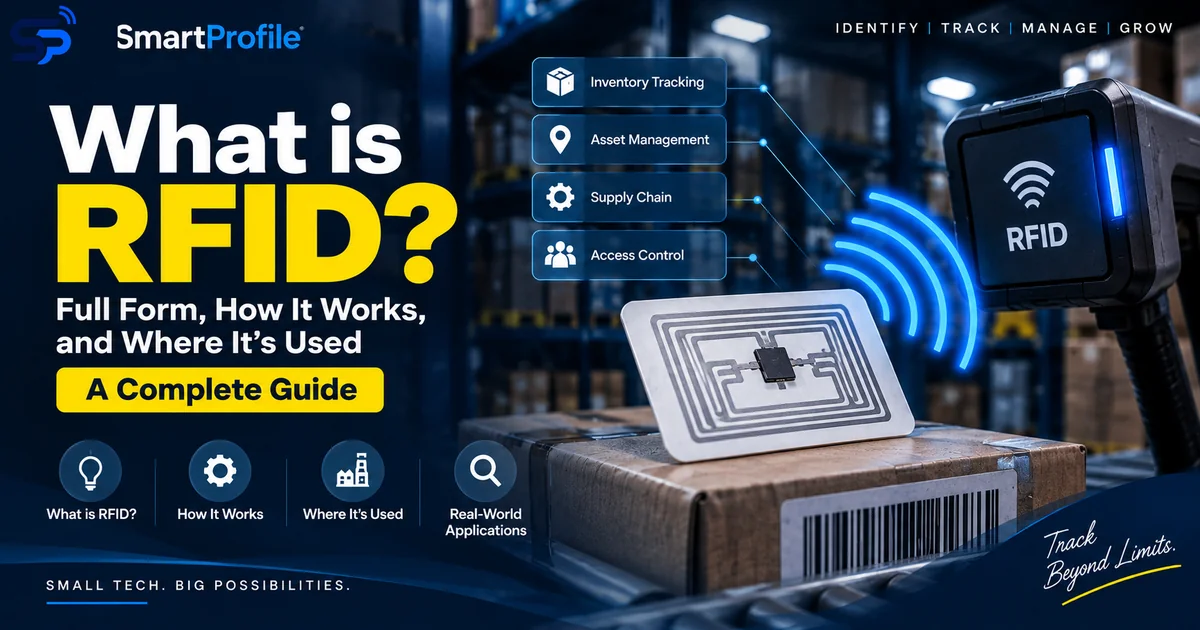
You've probably encountered RFID technology without even realizing it — at a store checkout, a highway toll booth, or scanning your office access card. But what is RFID exactly, what's its full form, and how does an RFID system actually work? Here's a complete, easy-to-understand guide.
RFID Full Form and Meaning
RFID stands for Radio Frequency Identification. It's a wireless RFID technology that uses radio waves to automatically identify and track tags attached to objects, without needing direct line of sight — unlike a barcode scanner, which does.
In simple terms, RFID meaning comes down to this: it's a system that lets a reader "talk" to a tag using radio waves, so an object can be identified and tracked automatically.
RFID Full Form Across Industries
The full form stays exactly the same everywhere — Radio Frequency Identification — whether you're looking at RFID in banking, logistics, IoT, railways, computing, or healthcare. What changes is only how the technology gets applied: banks and toll systems like FASTag use RFID for contactless payments, logistics companies use it for shipment tracking, IoT devices use RFID tags as low-power identifiers, and hospitals use it to track equipment and patient wristbands. In Hindi, RFID ka full form is the same — Radio Frequency Identification (रेडियो फ्रीक्वेंसी आइडेंटिफिकेशन).
How Does an RFID System Work?
A complete RFID system has four main parts:
1. RFID Tag — A small chip attached to an antenna, embedded in a label, card, or object. It stores a unique identifier and sometimes additional data. This is the part physically attached to whatever is being tracked.
2. RFID Reader (RFID Scanner) — A device that emits radio waves and captures signals sent back by tags within its range. RFID readers are sometimes also called RFID scanners, and can be fixed (mounted at doorways or checkout counters) or handheld.
3. Antenna — Converts electrical signals into radio waves and vice versa, enabling communication between the reader and tag.
4. Host System / Software — Processes and stores the data captured by the reader, connecting it to inventory systems, access control databases, or other business software.
When a tag enters the reader's field, the reader's radio signal powers up the tag (in passive systems) or wakes it (in active systems), and the tag transmits its stored data back to the reader, which then processes the information through the host system. This is how RFID identification and RFID tracking work together in practice.
Types of RFID Tags
Passive RFID Tags — Have no internal power source; they draw power from the reader's signal. Cheaper, smaller, and used for shorter-range applications like retail tags and access cards.
Active RFID Tags — Have their own battery and can transmit signals over much longer distances (up to 100 meters or more). Used for tracking large assets like shipping containers or vehicles. When comparing passive RFID vs active RFID, the choice usually comes down to range needed and budget — passive is cheaper and sufficient for most short-range business uses, while active suits large-scale, long-distance tracking.
Semi-Passive RFID Tags — Use a battery to power the chip's circuitry but still rely on the reader's signal to transmit data, offering a middle ground between passive and active.
RFID Frequency Ranges
RFID systems operate on different frequency bands, each suited to different use cases:
Low Frequency (LF) — 125–134 kHz, short range (a few cm), used in animal tracking and access control.
High Frequency (HF) — 13.56 MHz, range up to ~1 meter, used in smart cards and NFC-based applications.
Ultra High Frequency (UHF) — 860–960 MHz, range up to several meters, used in supply chain and inventory tracking.
Comparing LF vs HF vs UHF RFID mainly comes down to range and cost — LF is cheapest but shortest range, UHF gives the longest range and is most common in large-scale logistics.
Common Applications of RFID
Retail and Inventory Management — Stores use RFID tags to track stock levels in real time, reducing manual counting and preventing stockouts. This is one of the most common RFID uses in business today.
Toll Collection — Systems like FASTag in India use RFID tags mounted on vehicle windshields, allowing automatic toll deduction as the vehicle passes through a toll booth, without stopping.
Access Control — Office ID cards and building access badges commonly use RFID to grant or restrict entry to secure areas.
Supply Chain and Logistics — Warehouses and shipping companies use RFID for asset tracking of pallets, containers, and individual items as they move through the supply chain, improving accuracy and reducing loss.
Livestock and Asset Tracking — Farms use RFID ear tags to monitor animal health and location; companies use RFID tags to track expensive equipment.
Anti-Theft Systems — Retail stores embed RFID tags in merchandise, triggering an alarm if an item passes through an exit gate without being deactivated at checkout.
Advantages of RFID
No line-of-sight required, unlike barcodes.
Can read multiple tags simultaneously.
Durable — tags can withstand harsh environments better than printed barcodes.
Faster data capture at scale, ideal for inventory and logistics.
Limitations of RFID
Higher cost per tag compared to barcodes.
Signal can be affected by metal or liquid interference.
Privacy concerns, since tags can sometimes be read without the owner's knowledge if not properly secured.
Requires investment in readers and infrastructure.
What Is RFID Blocking? Do You Need an RFID-Blocking Wallet?
RFID blocking refers to material — usually a thin metal layer or specially woven fabric — built into a wallet, card sleeve, or bag that stops radio waves from reaching the RFID chip inside your cards. The idea is to prevent "RFID skimming": a scenario where someone with a hidden RFID/NFC reader walks close enough to read the data on your contactless debit card, credit card, or passport without physically touching it.
Here's the more balanced picture. Most contactless payment cards issued today use short-range NFC (not long-range RFID) and rely on additional security layers — encrypted chip data, tokenization, and per-transaction limits — that a skimmer alone can't bypass to actually complete a payment. Documented real-world RFID skimming theft is rare, and independent security researchers have generally found it harder to pull off in practice than RFID-blocking product marketing suggests.
That said, an RFID-blocking wallet isn't a bad idea if:
You carry a passport or ID with an embedded RFID/NFC chip and travel frequently, since these can store more identifying data.
You want peace of mind at low cost — a blocking wallet or sleeve is inexpensive and does no harm, even where the real-world risk is limited.
Your workplace uses RFID access badges and you want to avoid accidental cloning or unwanted reads near card readers.
If you're mainly worried about your everyday debit or credit card, the practical risk is low, and safeguards like tap-to-pay transaction limits already provide meaningful protection. RFID blocking is a reasonable extra precaution for some situations, not a strict necessity for most people.
RFID vs Barcode
Barcodes require direct line-of-sight scanning and can only be read one at a time, while RFID doesn't need line of sight and can read multiple tags simultaneously, often from a distance. This makes RFID faster for bulk inventory counts, though barcodes remain cheaper for simple, low-volume tracking needs.
RFID vs NFC — A Quick Note
NFC (Near Field Communication) is actually a specialized type of RFID technology, designed specifically for very short-range, secure communication — typically within a few centimetres — and used in applications like contactless payments and NFC business cards. If you're deciding which technology fits your use case, our detailed comparison breaks down exactly when to use each.
For close-proximity, tap-based interactions like sharing a digital business card, NFC is the better fit. For inventory or asset tracking across longer distances, RFID (specifically UHF) is the stronger choice.