NFC vs RFID: What's the Difference? (Complete Guide)
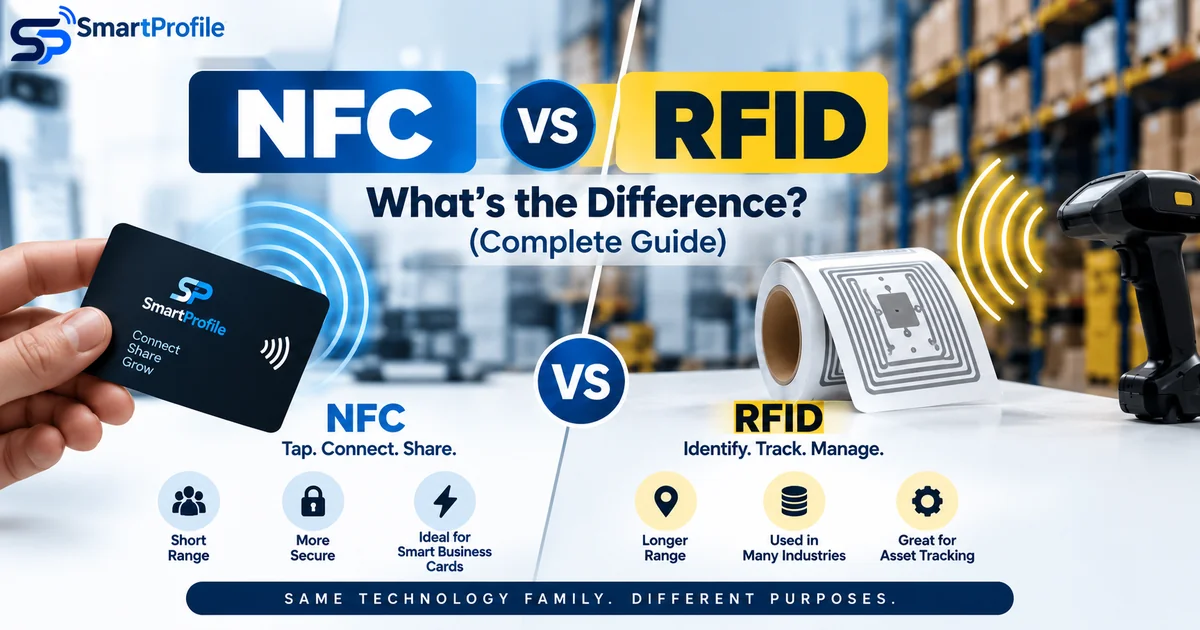
If you've been researching NFC business cards or smart cards, you've probably come across the term RFID too — and wondered, is NFC RFID, or something different? They're related, but not identical. Understanding the difference between NFC and RFID helps you pick the right technology for your business, whether that's a digital visiting card, an access control system, or inventory tracking.
What is RFID?
RFID stands for Radio Frequency Identification. It's a broad technology that uses radio waves to identify and track tags attached to objects. An RFID reader sends out a radio signal, and a tag (which contains a small chip and antenna) responds with its stored data.
RFID has been around since the mid-20th century and is used in a huge range of applications — from tracking pallets in a warehouse to toll collection systems like FASTag, retail anti-theft tags, and livestock tracking.
RFID tags come in two main types: passive (no battery, powered by the reader's signal) and active (battery-powered, used for long-range tracking). Read ranges vary widely, from a few centimeters up to several meters, depending on the frequency band and tag type used.
What is NFC?
NFC stands for Near Field Communication (see our full breakdown of the term for more). It's actually a specialized subset of RFID technology — so if you've ever wondered "is NFC a type of RFID," the answer is yes. NFC is built on the same basic radio-wave principle as RFID technology but is designed specifically for very short-range, secure communication — typically within a few centimetres.
NFC is what powers contactless payments (tap-to-pay), NFC business cards, smart posters, and phone-to-phone data sharing. Most smartphones today have an NFC chip built in, which is why tapping an NFC card or tag to a phone can instantly open a website, save a contact, or complete a payment.
NFC vs RFID: Key Differences
1. Range
RFID can work from a few centimeters to several meters away, depending on the frequency (Low Frequency, High Frequency, or Ultra High Frequency). NFC is intentionally limited to about a few centimetres, which makes it more secure for sensitive transactions like payments. If you're comparing NFC vs RFID range specifically, this is usually the biggest deciding factor.
2. Frequency
Both NFC and RFID use radio frequency, but NFC always operates on the 13.56 MHz High Frequency (HF) band. RFID, on the other hand, can run on Low Frequency, High Frequency, or Ultra High Frequency bands, giving it much wider flexibility depending on the application.
3. Communication Direction
Most RFID systems are one-way: the reader queries the tag, and the tag responds. NFC supports two-way, peer-to-peer communication — meaning two NFC-enabled devices (like two phones) can exchange data directly, not just a reader talking to a passive tag.
4. Speed and Data Transfer
NFC generally transfers data at lower speeds compared to some RFID systems, but it's fast enough for its intended use cases — tap-and-go payments, sharing a contact card, or opening a link.
5. Security
Because of its extremely short range, NFC is considered more secure for close-proximity, sensitive interactions like payments — an attacker would need to be within a few centimeters to intercept a signal. Long-range RFID, by contrast, is more vulnerable to unauthorized scanning from a distance if not properly secured.
6. Cost
NFC tags and NFC-enabled cards are generally similar in price to passive HF RFID tags, since NFC is technically a type of HF RFID. However, active RFID tags (used for long-range asset tracking) tend to cost significantly more due to their built-in battery and longer range circuitry. For most small business use cases like business cards or access badges, NFC and passive RFID cards are comparably priced.
7. Applications
RFID: warehouse and inventory management, supply chain tracking, toll collection, animal tracking, retail anti-theft.
NFC: contactless payments, NFC business cards, smart posters, access badges, phone pairing, smart packaging.
NFC Card vs RFID Card
Since both come in card form, people often ask specifically about NFC card vs RFID card. Here's the simple distinction:
An NFC card is designed for close-range tap interactions with a smartphone — no separate reader device needed, since the phone itself acts as the reader. This is exactly how a digital business card or contactless payment card works.
An RFID card (outside the NFC/HF range) may need a dedicated RFID reader device, and can potentially be read from a greater distance — useful for things like office access control or transit cards, where a person just needs to be near a reader rather than tapping directly.
For anything involving a smartphone tap — like sharing your contact details — NFC is the practical choice, since virtually every modern phone already supports it.
Which One Do You Need?
If you're looking for a technology to power a digital business card or smart business card — where someone taps their phone to your card and instantly views your profile, saves your contact, or visits your website — NFC is exactly what you need. It's built for this kind of quick, secure, close-range interaction, making it ideal for networking and professional use.
If you're running a large warehouse, tracking thousands of items across a supply chain, or need to scan tags without a person manually tapping each one, RFID with a longer range would be a better fit.
For SmartProfile's NFC Smart Cards, we use NFC specifically because it works instantly with any modern smartphone — no app download needed — and the tap-based interaction feels natural for networking and sharing your NFC business card. It's a simple, contactless business card experience that works for professionals and small businesses alike.
NFC vs QR Code — A Related Question
Since we're on the topic, many people also ask how NFC compares to QR codes for business cards. We've covered that in detail in our post on NFC Business Card vs QR Code — in short, NFC offers a tap-based experience while QR codes need a camera scan, and many modern digital business cards (like SmartProfile's) support both for maximum compatibility.